Which Players are Leading the Race in the Europe Edge Computing Market?
The Europe Edge Computing Market is experiencing significant growth as businesses shift toward decentralized data processing to improve efficiency and reduce latency. Driven by the increasing adoption of IoT, 5G networks, and AI applications, the market is projected to expand rapidly in industries such as healthcare, manufacturing, and retail.
As businesses demand faster data processing closer to the source, cloud service providers and technology giants are competing to dominate this space. Companies like Microsoft and Amazon Web Services (AWS) are investing heavily in edge computing infrastructure, offering innovative solutions to enterprises across Europe.
According to industry analysis, Microsoft and AWS are leading the Europe Edge Computing Market with their extensive cloud platforms and strategic partnerships. Their ongoing developments in AI-driven computing, distributed cloud architecture, and enterprise-grade security further strengthen their market dominance.
For a deeper insight into the competitive landscape and market trends, check out the Europe Edge Computing Market Report.
Microsoft vs. AWS: A Head-to-Head Comparison
Both Microsoft and AWS are leading the edge computing market, offering enterprises the tools needed to process data with low latency and high security. Here's how they compare:
Feature | Microsoft Azure Edge | AWS Edge Services |
Core Offering | Azure Stack Edge | AWS Local Zones, Wavelength |
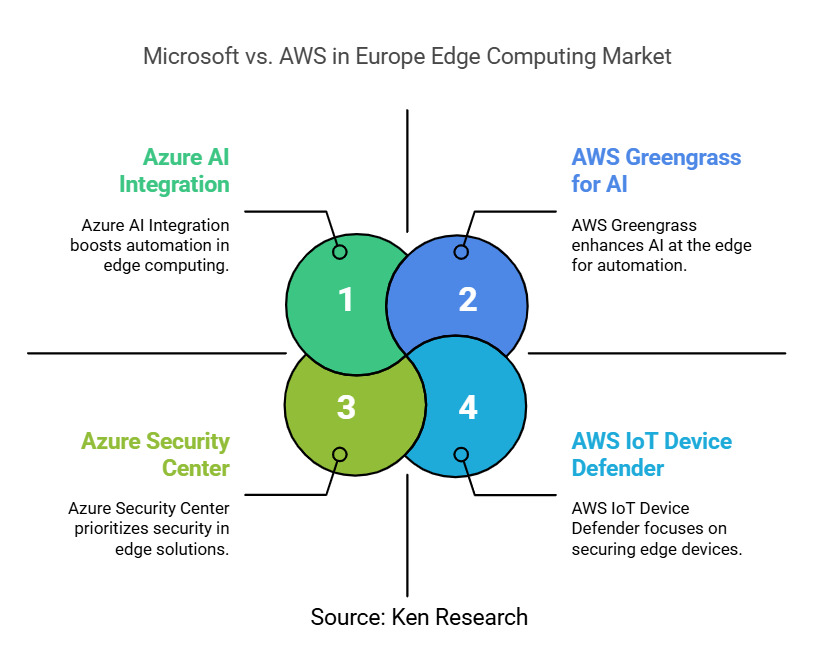
AI & Automation | Integrated with Azure AI | Uses AWS Greengrass for AI at the edge |
Security | Azure Security Center | AWS IoT Device Defender |
Industries Served | Healthcare, Retail, Smart Cities | Gaming, Media, Manufacturing |
Recent Developments | Expansion of edge zones across Europe | New AWS Outposts deployment in European regions |
Microsoft’s Strategy in Edge Computing
Microsoft's Azure Edge focuses on seamless cloud-to-edge integration. The company is investing in AI-enhanced edge computing, enabling enterprises to run workloads closer to data sources for real-time processing.
Recent initiatives include:
- Expansion of Azure Edge Zones across Europe for better 5G connectivity.
- Integration of AI-powered automation to improve cloud-to-edge computing efficiency.
- Strategic partnerships with telecom providers to enhance edge-based network services.
AWS's Competitive Edge
AWS takes a distributed approach to edge computing, leveraging services like AWS Wavelength and Local Zones to reduce latency. Their focus on gaming, media, and manufacturing industries has positioned them as a dominant force in the market.
Key initiatives include:
- Expansion of AWS Local Zones in major European cities to support real-time applications.
- AWS Outposts and Wavelength integration for telecom networks to power 5G-based edge computing.
- Investment in AI-powered edge computing for real-time analytics and predictive maintenance.
Future Market Opportunities in the Europe Edge Computing Market
Growing Demand for AI-Powered Edge Computing
The adoption of AI-driven edge computing is expected to skyrocket. Industries such as healthcare and finance are leveraging AI models at the edge to enable faster decision-making and improved security. By 2025, nearly 60% of enterprises in Europe will deploy AI-based edge solutions to manage data more efficiently.
Expansion into Emerging Sectors
With the increasing demand for autonomous vehicles, industrial automation, and smart infrastructure, Europe’s edge computing market will witness multi-billion-dollar investments. Companies like AWS and Microsoft are strategically partnering with telecom operators to power these emerging use cases.
For more insights into cloud-driven computing innovations, the India Cloud Computing Market Report.
Conclusion
The Europe Edge Computing Market is a battleground for Microsoft and AWS, both aiming to lead the industry through cloud-based edge solutions, AI-powered automation, and 5G connectivity. With continuous investments in infrastructure expansion and security enhancements, both players will play a pivotal role in shaping the future of edge computing.
As the demand for real-time data processing and low-latency solutions continues to grow, the competition between Microsoft and AWS will push further innovations in AI-driven edge computing and distributed cloud services.
For a deeper dive into market trends, you can download the Sample Report.
More Reads
- Vietnam Carbon Black Market: Growth Drivers & Future Outlook